GOES-R Training Overview
+ GOES-R 101 + COMET + VISIT + SPoRT + NOAA Training and Test Beds
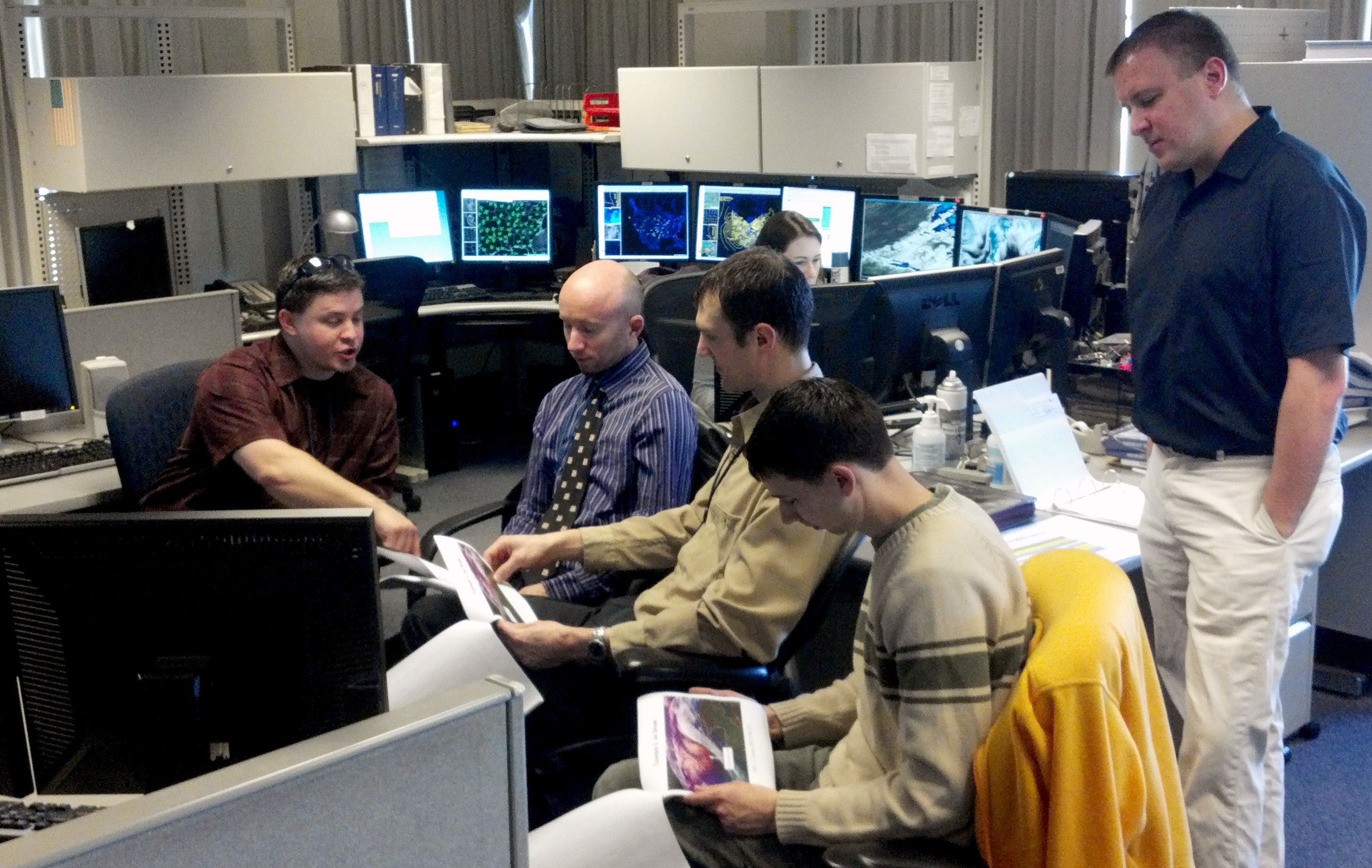
image:  training
The GOES-R Program is committed to providing extensive training for the operational and educational communities, including: NWS forecasters; FAA meteorologists; coastal service centers; air quality modelers; climatologists; broadcast meteorologists; university faculty; researchers; meteorology students; the international community; and NOAA management, in preparation for the future GOES-R system.

Training will address both the end users’ and developers’ needs, bridging the gap between research and operations. It will focus on the quantitative and qualitative use of GOES-R data and products, methods for interpreting GOES-R data, new capabilities and algorithms, and a better understanding of atmospheric sciences and mesoscale meteorology.

GOES-R training is developed and provided by a number of different partners across the weather enterprise. NOAA, collaboratively through the National Environmental Satellite, Data, and Information Service (NESDIS) and the National Weather Service (NWS), partners with the Cooperative Program for Operational Meteorology, Education, and Training (COMET), the Virtual Institute for Satellite Information Training (VISIT), and the Short-term Prediction Research and Transition Center (SPoRT) to develop and deliver training on the new features, operations, and capabilities of the GOES-R Series satellites.

Training specific to the GOES-R Proving Ground, Hazardous Weather Test Bed Spring Experiment, Joint Hurricane Test Bed, and many other NOAA Test Beds is provided through e-learning training modules, seminars, weather event simulations, and special case studies.

The GOES-R Program has also implemented the position of “Satellite Champion” to prepare forecasters for the data that will be available with GOES-R and to ease the transition to operations. Satellite Champions are stationed at most of the National Centers and the NWS Training Center. Satellite Champions are tasked with running the various GOES-R demonstrations within these testbed locations. They are essentially research-to-operations liaisons, improving upon training from the product developers to present to testbed participants, and providing participant feedback to the developers for further improvement.

For a briefing on the GOES-R Training Approach, click here.

Training Modules and Resources
GOES-R 101
COMET logo
Targeted for Forecasters and anyone else interested in basic aspects of GOES-R.  View Training Site
image:  top arrow pointing to top of page top
Cooperative Program for Operational Meteorology, Education, and Training (COMET) Program
COMET logo
The Cooperative Program for Operational Meteorology, Education, and Training (COMET) Program supports, enhances, and stimulates the communication and application of scientific knowledge of the atmospheric and related sciences for the operational and educational communities. The COMET Distance Education Program training materials include web, CD-ROM, and teletraining methods which serve earth science education and training needs by providing interactive experiences for learners at a distance. COMET Meteorology Education and Training (MetEd) Satellite Meteorology Courses and Modules include training on remote sensing, satellite sounding, creating meteorological products from satellite data, satellite feature identification, and much more. For an introduction to satellite remote sensing click here.

Atmospheric Dust
New!  Atmospheric Dust:  Atmospheric dust storms are common in many of the world's semi-arid and arid regions and can impact local, regional, and even global weather, agriculture, public health, transportation, industry, and ocean health. This module takes a multifaceted approach to studying atmospheric dust storms.
Creating Meteorological Products from Satellite Data
Creating Meteorological Products from Satellite Data:  This module presents an overview of how satellite data are turned into the satellite products used by operational forecasters and the research and educational communities, etc.
Dynamic Feature Identification: The Satellite Palette
Dynamic Feature Identification: The Satellite Palette:  This series addresses the use of satellite imagery and focuses attention on the identification of dynamic features using high-resolution satellite imagery with NWP verification.
Forecasting Dust Storms, Version 2
Forecasting Dust Storms, Version 2:  Forecasting Dust Storms Version 2 provides background and operational information about dust storms.
       
Satellite Meteorology: GOES Channel Selection Version 2
New! Satellite Meteorology: GOES Channel Selection Version 2:  This module includes significant updates to the module "Satellite Meteorology: GOES Channel Selection." It still reviews the five GOES imager channels and their use, incorporating updated technical information, conceptual visualizations and numerous imagery examples. This module is also available in Spanish.
GOES-R: Benefits of Next-Generation Environmental Monitoring
GOES-R: Benefits of Next-Generation Environmental Monitoring:   An overview of the GOES-R mission, instruments, system and services, satellite synergy, the role of GOES-R in the Global Observing System as well as environmental monitoring section that addresses the benefits of GOES-R and the ability to monitor 13 unique hazards and phenomena. This module is also available in Spanish.
Introduction to Tropical Meteorology, 2nd Edition, Chapter 2: Remote Sensing
Introduction to Tropical Meteorology, 2nd Edition, Chapter 2: Remote Sensing:  This chapter focuses on remote sensing—the primary method of observing weather and climate across the global tropics. We will explore how remote sensing is used and examine the types of information that it provides over formerly data-void regions. This module is also available in Spanish.
Monitoring the Climate System with Satellites
New!  Monitoring the Climate System with Satellites:  This 2-hour module describes the unique role that environmental satellites play in monitoring the Essential Climate Variables (ECVs) that are key for measuring the climate system.
       
Multispectral Satellite Applications: Monitoring the Wildland Fire Cycle
Multispectral Satellite Applications: Monitoring the Wildland Fire Cycle:  This module describes current and future satellite instruments and products used for monitoring the fire cycle, with an emphasis on polar-orbiting satellites. This module is also available in Spanish.
Recognition and Impact of Vorticity Maxima and Minima in Satellite Imagery
Recognition and Impact of Vorticity Maxima and Minima in Satellite Imagery:  Vorticity maxima and minima signatures are common features of the atmosphere. They indicate areas of ascending and descending circulation and atmospheric forcing and can be used to diagnose dynamic features such as the axis of maximum winds and deformation zones. This module provides insight on the analysis of these dynamic atmospheric features using Meteosat Second Generation (MSG) satellite imagery.
Satellite Feature Identification: Atmospheric Rivers
New!  Satellite Feature Identification: Atmospheric Rivers:  Presents the global moisture transport phenomenon known as the Atmospheric River (AR). ARs are responsible for transporting the majority of maritime moisture from low to middle latitudes.
Satellite Feature Identification: Blocking Patterns
Satellite Feature Identification: Blocking Patterns:  Examines how water vapor imagery can be used to help diagnose blocking patterns and their dissipation. Four major blocking patterns are covered in this module: Blocking highs, Cut-off lows, Rex blocks, and Omega blocks. This module is also available in Spanish.
       
Satellite Feature Identification: Deformation Zone Analysis
Satellite Feature Identification: Deformation Zone Analysis:  The quick analysis of deformation zones provides an overview of system-relative atmospheric circulations. Since deformation is a primary factor in frontogenesis and frontolysis, understanding of these system-relative circulations is crucial to the diagnosis of atmospheric processes and weather prediction. This module is also available in Spanish.
Satellite Feature Identification: Deformation Zone Diagnosis
Satellite Feature Identification: Deformation Zone Diagnosis:  Following an analysis of the main features of a deformation zone, the diagnosis of temporal and spatial changes in these features can be used to deduce underlying meteorological processes and their progression. In turn, this knowledge can then be used in the forecast process to adjust the forecast accordingly.
Satellite Feature Identification: Deformation Zone Distribution
Satellite Feature Identification: Deformation Zone Distribution:  The distribution of vorticity centres along an axis of maximum winds follows a fairly predictable pattern based on the characteristics of the flow. By diagnosing these characteristics, the meteorologist is able to quickly deduce the location and relative intensities of the associated vorticity centres as well as the relative sizes of the associated circulations.
Satellite Feature Identification: Ring of Fire
Satellite Feature Identification: Ring of Fire: Introduces forecasters to the potentially damaging convection that can develop in conjunction with blocking high pressure centers and examines how to identify it from a water vapor imagery perspective. This module is also available in Spanish.
       
Satellite Meteorology: Introduction to Using the GOES Sounder
Satellite Meteorology: Introduction to Using the GOES Sounder:  This module, adapted for the Web from the CD-ROM released in 1998, reviews GOES sounder characteristics, data products, and applications concurrent with the GOES I(8)-P satellites.
Space Weather Basics, 2nd Edition
Satellite Meteorology: Introduction to Using the GOES Sounder:  This module presents an overview of space weather processes, their impacts on Earth and human activities, and the technologies used for forecasting space weather events.
For a complete list of
MetEd Satellite Meteorology
Courses
please click here.

Environmental Satellite Resource Center (ESRC):
COMET logo
The COMET Program has also developed the Environmental Satellite Resource Center (ESRC) as a searchable, database-driven website that provides easy access to a wide range of useful information and training materials on polar-orbiting and geostationary satellites, provided by the global environmental satellite
  community. Primarily sponsored by the National Polar-orbiting Operational Environmental Satellite System (NPOESS) Program and the National Oceanic and Atmospheric Administration (NOAA), the ESRC is intended for users seeking reliable sources of satellite information, training, and data.
image:  top arrow pointing to top of page top

Virtual Institute for Satellite Integration Training (VISIT):
COMET logo
Virtual Institute for Satellite Integration Training (VISIT) is a joint effort involving NOAA Cooperative Institutes, the National Environmental Satellite Data and Information Service (NESDIS), and the National Weather Service (NWS). The primary mission of VISIT is to accelerate the transfer of research results based on atmospheric remote sensing data into NWS operations using distance education techniques. Training sessions include topics on Satellite Meteorology, Severe Weather, Climate, Numerical Weather Prediction, and more.

A selection of  VISIT training sessions specific to GOES is listed below:

Utility of GOES Satellite Imagery in Forecasting/Nowcasting Severe Weather Includes information on assessing model performance, air mass identification, identification of changes in the pre-storm environment, and monitoring the changing environment.

MODIS Products in AWIPS:  Basic-level VISIT teletraining lesson that describes the MODerate-resolution Imaging Spectroradiometer (MODIS) imagery and products. A variety of MODIS examples will demonstrate the unique operational utility of these new satellite products, which will help forecasters prepare for new satellite channels and products coming in the GOES-R era.

GOES Sounder Data and Products: Introductory-level teletraining module that provides an introduction to the data and products available from the latest generation of GOES Sounder instruments, along with examples of sounder Derived Product Imagery (DPI) and their applications to weather analysis and forecasting.

Ensemble Tropical Rainfall Potential (eTRaP):  Provides a basic understanding of the eTRaP product, which is used for rainfall prediction of landfalling tropical cyclones. The lesson covers the assumptions that go into creating the product, an understanding of these assumptions is crucial to interpretation of the product. This training session also covers the eTRaP web-page so that the student may efficiently find the products they need.

The UW Convective Initiation Product:  This teletraining describes the University of Wisconsin Convective Initiation (UWCI) product, which tracks cloud top temperatures and cloud types to determine when a particular cloud pixel is growing in the vertical.

Synthetic Imagery in Forecasting Severe Weather:  This training session considers applications of the synthetic imagery towards severe weather events. The primary motivation for looking at synthetic imagery is that you can see many processes in an integrated way compared with looking at numerous model fields and integrating them mentally. This session is helpful in learning how to use/interpret the GOES-R Proving Ground "Cloud and Moisture Imagery" products.
  Synthetic Imagery in Forecasting Orographic Cirrus:  Forecasting orographic cirrus is important because of their influence on temperature forecasts. Utilizing synthetic imagery generated from a model is a useful way to anticipate orographic cirrus. Orographic cirrus can be more easily visualized on synthetic imagery compared to model output fields such as relative humidity over some layer. This session is helpful in learning how to use/interpret the GOES-R Proving Ground "Cloud and Moisture Imagery" products.

COMET logo
The Satellite Hydrology and Meteorology (SHyMeT) course is dedicated to operational satellite meteorology. The goal of this course is to foster the development of satellite expertise among those who need to incorporate the latest data and products into mission critical operations. A key aspect of this satellite-training program is the linkage of new data, products, and forecasting techniques.

Currently, there are four tracks of the SHyMet course available:

SHyMet For Forecasters:
The Forecaster track of the SHyMet course covers satellite imagery interpretation, including feature identification, water vapor channels, and what to expect on GOES-R. There is a session on remote sensing data for operational hydrology as well as one relating to aviation hazards. Other topics include an understanding of the Dvorak method in tropical cyclone analysis and the utility of cloud composites in forecasting. Click here for the Forecaster course.

SHyMet For Interns:
The Intern track will touch on Geostationary and Polar orbiting satellite basics (areal coverage and image frequency), identification of atmospheric and surface phenomena, and provide examples of the integration of meteorological techniques with satellite observing capabilities. This course is open to anyone inside or outside of NOAA who wishes to review the "basics" of satellite meteorology. Click here for the Intern course.

SHyMet Severe Thunderstorm Forecasting:
The Severe Thunderstorm Forecasting track of the SHyMet course covers how to integrate satellite imagery interpretation with other datasets in analyzing severe thunderstorm events. Click here for the Severe Thunderstom Forecasting course.

Tropical SHyMet Introduction:
The Tropical track of the SHyMet course will cover satellite imagery interpretation and application of satellite derived products in the tropics as well as the models used at NHC for tropical cyclone forecasting. Click here for the Tropical SHyMet Introduction.


For a full list of VISIT training session topics, please click here.


image:  top arrow pointing to top of page top
NASA’s Short-term Prediction Research and Transition Center (SPoRT):
COMET logo
NASA’s Short-term Prediction Research and Transition Center (SPoRT) provides training about specific products, discussing the strengths and weaknesses, with the goal of successfully transitioning products to
  operations. This training is built from surveys and direct communication with our partners. With this paradigm, the forecasters are an integral component of the transition process and not a passive recipient of data. SPoRT Product Training Modules include: Pseudo Geostationary Lightning Mapper, Lightning Mapping Array, MODIS Fog Products, GOES Fog Depth, and more. For a complete list of training modules, please click here.

image:  top arrow pointing to top of page top
Weather Event Simulator:
Weather Event Simulator:    Advanced Baseline Imager
image:  top arrow pointing to top of page top
NOAA Training and Test Beds
NOAA Training Resources

NOAA has a well-established training program that will support GOES-R User Readiness:

The Warning Decision Training Branch (WDTB) develops and delivers training on the integrated elements of the warning process involving a National Oceanic and Atmospheric Administration (NOAA)/National Weather Service (NWS) forecast office and its partners. WDTB instructors develop and deliver a variety of in-residence, teletraining, and on-line asynchronous training content to meet this mission.

The Forecast Decision Training Branch (FDTB) of the NWS Training Division develops and delivers training on the integrated elements of the forecast and warning process within NWS forecast offices, national centers, CWSUs and river forecast centers. FDTB instructors develop and deliver a variety of on-line asynchronous training, virtual courses, teletraining, and simulations to meet this mission.

The Office of Climate, Water, and Weather Services (OCWWS) Training Division ensures that NWS staff receive the training required to attain/maintain proficiency in providing accurate and timely forecasts and warnings to the public.

The NWS Training Center (NWSTC) provides training to NOAA / NWS employees in the areas of management, meteorology, hydrology, equipment maintenance, systems support, and related activities. Under the NWSTC, a new Operations Proving Ground in Kansas City, MO has been established and will be the main focus of obtaining and creating new training on GOES-R products for National Weather Service (NWS) forecasters and other NOAA users.

NOAA Test Beds

The NOAA Test Beds serve as a bridge between research and operations, accelerating research and development and enhancing the infusion of research into forecasting operations by allowing forecasters and researchers to join forces in an operational setting.

Hazardous Weather Test Bed:
NOAA's Hazardous Weather Test Bed (HWT) is a facility jointly managed by NOAA’s National Severe Storms Laboratory (NSSL), the Storm Prediction Center (SPC), and the NWS Oklahoma City/Norman Weather Forecast Office (OUN) within the National Weather Center building on the University of Oklahoma South Research Campus. The HWT is designed to accelerate the transition of promising new meteorological insights and technologies into advances in forecasting and warning for hazardous mesoscale weather events throughout the United States. The HWT facilities include a combined forecast and research area situated between the operations rooms of the SPC and OUN, and a nearby development laboratory. Click here to learn more about the HWT.
 
Hydrometeorology Test Bed:
The Hydrometeorology Test Bed (HMT) is a concept aimed at accelerating the infusion of new technologies, models, and scientific results from the research community into daily forecasting operations of the National Weather Service (NWS) and its River Forecast Centers (RFCs). HMT is a key R&D approach for improving flood forecasts. Click here to learn more about the HMT.
 
Satellite Algorithm Test Bed:
The Satellite Algorithm Test Bed (SATB) accelerates the development, implementation, delivery, and operational application of new/improved environmental satellite data products. The goal of the SATB is to provide the scientific community access to all publicly available primary earth observing satellite data streams and associated infrastructure and funding so that they are able to conduct applied research.
 
Aviation Weather Test Bed:
The Aviation Weather Test Bed (AWT) provides a means of testing new science and technology for the purpose of eventually producing better aviation weather products and services. The execution of the Test Bed is accomplished via close collaboration between the AWC and its many partners. Click here to learn more about the AWT.
 
Joint Hurricane Test Bed:
The mission of the Joint Hurricane Test Bed (JHT) is to transfer more rapidly and smoothly new technology, research results, and observational advances of the United States Weather Research Program (USWRP), its sponsoring agencies, the academic community, and other groups into improved tropical cyclone analysis and prediction at operational centers. Click here to learn more about the JHT.
 
Joint Center for Satellite Data Assimilation:
The Joint Center for Satellite Data Assimilation (JCSDA) is dedicated to developing and improving the ability to exploit satellite data more effectively in the United States. The JCSDA is a distributed collaborative effort that allows the work required to use the billions of satellite observations available daily to be shared by several operational agencies in the United States. Click here to learn more about the JCSDA.

image:  top arrow pointing to top of page top


Home Contact Us FOIA Privacy Disclaimer FAQs Site Map image: USA.gov logo
Link to NOAA's home page Link to NASA home page Link to GOES-R home page